Search This Blog

Showing posts with label AOy7. Show all posts

Saturday, May 19, 2012

Current Events: On the go

Once upon a time, I was starting this really cool (and time consuming) custom of posting links to online articles written about current events in history both for my AOy7 boys (and anyone else who cared to share). Since over the last insanely busy weeks (months?), I've not had time to choose articles for the "This Week in History" feature, I've reverted to using a VERY easy option for kindling ideas for entries in the boys' journals. I've recently subscribed to World Magazine Podcasts; this is not quite the same as 'reading' the newspaper or news magazine, but very much more convenient. 

Basically, the podcasts are the radio blurbs World magazine broadcasts - summaries of what's going on in the world. Ideally, these would work to simply spark an interest in something and on their own initiative they could look up an article to expand their knowledge on the subject. Until things settle down, I'm just happy that the boys listened to the weekly hour long podcast and are now writing in their journals about whichever news item struck their fancy.


World Magazine Podcasts


There are two features: The daily radio blurb, "This is News" from World Magazine and the weekly hour long program "The World and Everything in It" which covers news as well as a little bit of everything else, as the name suggests. :) The lastest episode had a literature theme for example and discussed the anniversary of C.S. Lewis' Screwtape Letters (I did skip over some brief spots re: movies and books - gotta love that feature as opposed to listening to live radio! All things were handled appropriately, but I had my smaller kids nearby as well).

Click the links above to subscribe via rss on the World magazine website or subscribe via itunes.


Helpful Links:
Current Events: What we do
Fisher Academy Current Events posts
Current Events page @ AmblesideOnline.com

Monday, March 19, 2012

For Novice Poetry Analysts... like me!

How to analyze a poem!

Prerequisite:
Grammar of Poetry (at least the first half)
In Grammar of Poetry, students will have already gone over and practiced basics of metaphors, similes, meter, personification, alliteration, etc, etc.
Level: AOY7+/-  *Please don't make your young children analyze poetry! It takes all the joy right out of it! Beginning in Form IV (roughly grades 7-9), Mason had the students note the meter and other technical details of the poems. See this post's Helpful Links for some more really great online resources for teaching the technical details in later years.


Please note: The purpose of what I'm suggesting in this initial activity using the following website with your students, is NOT to follow the exercise as perhaps was intended on the website itself. The idea is to use the info as presented there as an example of things to think about and the questions we might ask when WE are analyzing poetry with our students. :) You would probably not do this more than once as a lesson, though I found it interesting to look through a couple of other poems at my own leisure, apart from my kids.
  1. Read this 
  2. Choose a poem from here (select a poem according to AO year/term? there are lots to choose from). We did this one by Tennyson called Break, Break, Break.
  3. Once you've chosen the poem, look/work through the links in order as presented on the site (click and read through all the links in each section) >> Intro (*spoiler alert* you may want to read the intro page last, so as not to give the whole thing away) >> The Poem >> Summary >> Analysis (I definitely recommend skipping links Calling Card ->through-> Steaminess Rating) >> Themes >> actually, by the time we got to Quotes and then Study Questions, we'd already gleaned what we were gonna glean. You may wanna skip those too.
So, to sum up what we learned above:

Analyzing a poem will consist of at least several of the following activities:
Choosing a poem.
Reading the poem (several times!).
Writing a short summary of the whole poem (an overall impression).
Taking a stanza at a time, answering basic questions about each line (who is speaking, about what? etc., see the site again for examples of how to do this).

Giving examples of the following elements using the exact words from the poem (this is where grammar of poetry experience will come in real handy):
  • Symbolism
  • Imagery
  • Wordplay
  • Form and Meter (iambic, trochaic, anapest, dactyl)
  • Speaker (who is speaking?)
  • Sound (lilting, jerky, rhythmic, etc... how does this lend to the poem's overall effect?)
  • Where does it's title come from?
  • Themes (pick one or two and then quote the parts of the poem that support your thinking)
I'm planning to use some of the above to help form exam questions later on this term. :) OH yeah.

Please let me know if you have any great online poetry resources! Do you have any suggestions? What do you do to analyze poetry? I'm on a poetry kick and I'd love to look at your ideas! :)

Tuesday, March 13, 2012

Year 7: Poetry

Oh the joys of poetry! If we hadn't started reading poetry pretty early on, I might have been of the opinion that some of these poems are somewhat advanced for ME, let alone my kids... but, to the contrary, I'm actually excited to read these with the boys. Javen jumps at the chance when it's his turn to attempt the readings! What fun. :)

While, I personally love poetry, I still would like to learn a LOT more. You'll see that I've added a LOT of Helpful Links below in my search for online resources. They are mainly for my own reference, of course you're welcome to check any of them out that look interesting! ;)

Here are the AO year 7 poetry selections, to be split up over the three terms:  
Beginning in Form IV, Mason had the students note the metre and other technical details of the poems. See Helpful Links for Students below* for some really great online resources for teaching these details.


In year 7 as scheduled, we've started A Grammar of Poetry, by Matt Whitling. I highly recommend this book for teaching the beginning ins and outs of reading, writing and criticizing poetry. It's presented in a simple, quick and concise way. If you know exactly what you're looking for, you could probably search out all the materials for free on the internet, but to me, it is totally worth it to have bought the book! (The teacher's guide is GREAT!) If you do one lesson a week, your students should be able to begin to apply their new skills (noting meter and other technical details) to the y7 poetry selections by the second term. I'll have to let you know how this goes! ;)

For Recitation:
Praise of Woman (audio) & The True Knight
Familiar Quotations by John Bartlett

Helpful Links:
AO Poetry Schedule
Y7 Poetry Selections
{The following links, I selected because of the potential helpful content for us the teachers. I didn't thoroughly screen the sites, though in most cases I did look through the pages that are actually linked to. I mostly had teacher reference in mind though, so please don't set your students loose with them just because you found the links here ;) }
Schmoop - an online poetry textbook, boasting a great variety of classic poetry, and as they say, 'we speak student'. Shmoop.com is a digital textbook publisher and, as the site describes itself, "every teacher's and student's new BFF." I enjoyed reading this site :)
How to read a poem - in shortest, short, medium-ish and very, very long versions. 
Tips for Teaching Poetry - many ideas, some adaptable for co-ops and homeschools :)
Committed to Memory - an article written by a poet on the whys and hows of memorization/recitation of poetry
Terms for the Tools of Poetry - a great list of important terms, may be of special use to parents.
Listening for Tone - very interesting idea using a poem in Spanish to identify tone w/o understanding the actual language.
Teacher's Lounge - youngpoets.ca has compiled some very interesting articles for teaching poetry
Craft of Poetry - material about the fundamentals of poetry writtne in a fun way from a course used at University of Northern Iowa
Poetrykit.org - offers online poetry courses (not free)
poetrymagic.co.uk - provides a great checklist for critiquing poems
Poetry Glossary - useful for a checklist of sorts
Online Poetry Resources - poet.org
Ablemuse - a poetry forum for submitting and critiquing poetry
OpenUniversity's poetry course (free) - I have no idea if this is good... open course ware is a great idea!


Helpful Links for Students*:
{These links seemed very student friendly, and I did not see any unwholesome ads, but again, please always be careful!}
Poetry Meter
Rhythm, Scansion and Meter Made Easy - a quick reference guide
Poem Structure - Lines & Stanzas
Ryhme Schemes
Poetry Prompts and in that same vein some Story Starters
Types of Poems
How to Write Poetry

Friday, December 9, 2011

Fisher Days

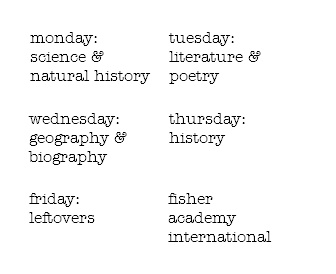
For some time now I've arranged our school by the day of the week. Have you seen that little ditty on my sidebar? Several people have asked about that, and it's time I updated and clarified :)
Oh, here it is:


It helps me to keep my head about me to have a loose idea of what we want to accomplish each day. I divide our work into subjects, which are designated to a certain day of the week. It doesn't mean we only do these things on the specified day of the week and no other... it just helps to know that everything will, or at least potentially could get done sometime during the week if all else gets crazy and unpredictable. Does that make sense? Schedules or checklists exist to serve me, I do not exist to serve the schedule! ;)
  • monday - science & natural history
  • tuesday - literature & poetry
  • wednesday - biography & geography
  • thursday - history
  • friday - leftovers
Friday is left free so that anything we don't get done during the week is done that day :)

When I only had two children in any given AO year, it was VERY simple, I didn't even have to write it out, and we rarely had to look at a schedule. We got into the habit quite quickly knowing which books were read on which day. 

This year, as I have four, it is a HUGE help to have the subjects divided by day... here are my thoughts about using this list in the different years:

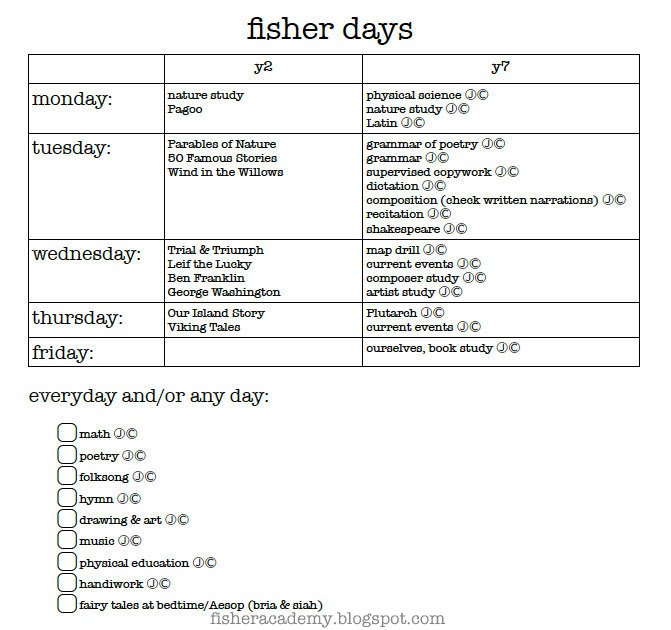
y2: I pretty much arrange the littles' entire day, every day (they still have plenty of free playtime in which I get to practice masterly inactivity). The amount of work in this combined year (see below) doesn't reflect a normal AO year. Even though their year is combined, there are several things that I only do with one or the other that I didn't put there on the list below.

y7: The bigger kids have arranged their schedules as they see fit when it comes to which books are read on which day at whatever time of day. :) But there are still quite a few things I help them with or am in some great way still involved. Their subjects that I am needed for are arranged by day. I commit to make myself available for those subjects at some time that day (usually before lunch). If they don't take advantage on that day, it gets pushed 'til Friday, or if neither of those, will have to be based on my availability at another time (meaning it may not get done that week).

Here's an example of our days:


Click to download

Thursday, November 17, 2011

Current Events: Our Method

Did you know that 1.73 people die while 4.13 are born every. single. second?  In the same fraction of time, 73 items are ordered over at amazon.com, and 50,000 e-mails are sent by yahoo alone.  In an age when it is virtually impossible to stay current on what is happening, as we are constantly inundated with information available on the instant from every corner of the earth with most anything you could possibly think of being googled at any hour of the day...

How does one discern what really matters? 
How do we remain current and not waste a ton of time?


Time Cover Story: How Twitter Will Change The Way We Live (in 140 characters of less)


Current Events. This year marks the first time I have put today's world in the hands of my older children. They've read books, they've talked with grown ups, but this is the first time they themselves will come face to face with the world as presented through the media. It isn't a safe or pretty place. In particular, because of the nature of the internet, and folly being only a mouse click away, it is vital that they not be left to their own devices or be given too much liberality when it comes to sifting through the headlines.

Dealing with Time and Developing Discernment. 

With so much information at their fingertips, how are they to know what to read? Obviously, if they pick something that simply isn't important, all is not lost; discernment will come with time. There is the good, there is seemingly a lot more of the bad, there is the appropriate and an unfortunate amount of the inappropriate. Someday, they will choose. all. by. themselves. EEK! At some point in time they will probably read things I'd rather they hadn't. Can we just come to terms with that? (no, believe me, I'd rather not)

In the meantime, I will try to teach them how to go about the choosing. After all, we are in the world, even if we are not of it. An understanding of which might just be the key to developing proper discernment. :)

However, with one computer, our main concern at this point is time. And all of our news sources online as they are, we don't have a lot of time to spare :)


The time factor:
  • Limiting time. This is a tool that I use as a grown up ALL of the time. I commonly limit the time I have to finish a certain task. I take 30min to read in the morning. We start school at 9am, for example. It is when I do NOT limit my time that I end up wasting hours upon hours getting super side-tracked or just plain lazy. A timer with a LOUD and annoying beep is a very helpful tool for practicing self control ;)
  • Limiting the sources was also a big help.  Limiting them even more will be even better. For now. In this way, I can use Masterly Inactivity, instead of hovering, pestering, or generally showing myself as a control freak. :)
  • They might also find that following a certain interest over the course of several weeks would be very interesting - discoveries made within a certain branch of Science, political issues, war and it's outworkings, a particular country in the news, etc. 
The discernment factor:
  • I thought that narrowing the selection would be a good way to keep them from being overwhelmed with the flood of information as well as time limits (they had 2 sites to choose from). It worked alright in that regard. But even with the limited choices, how were they to discern for themselves what items were worth their time? This is a big deal. I find that for myself, sensational headlines often draw my attention much quicker than the world happenings that really are affecting history.  
  • For now, I will be their discernment filter. I will choose for them. As we go along, I will dialogue with them about what is worthy of their time and what clearly is not. Later on, I will ask them to join me in deciding what news is pertinent for them to read. When I see a maturity and responsibility in this, I'll be happy to simply guide their choices. How long does this process take? Hah! I could foresee it being within a year's time, or several... it absolutely depends on the student!
So for now, here's what we do:
  1. I can usually tell, from family conversation about what is happening in the world and knowing my children well, what will interest them. Based on what the news is, I've picked 4-5 articles for them to choose from (this way I can print them off!).
  2. I like to add an article about the same event from more than one viewpoint/news source. I would love to always have a conservative print magazine (World) to compare with the more liberal media. 
  3. At some point, once we have some experience with this subject under our belts, I will graduate my kids to selecting their own articles from well-known and trusted sites. This will probably not take place until we have more than one computer between the 7 of us ;)


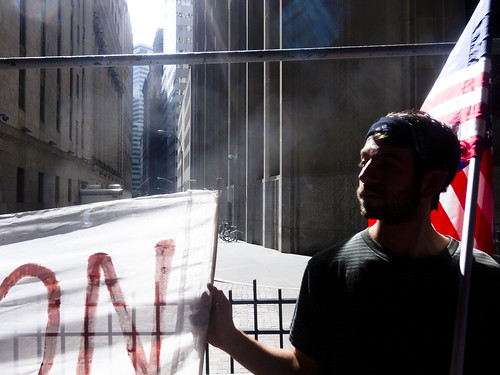
Anonymous Wall Street Protest


The links for this week:

Wall Street Protestors Decry “Gilded Age” : 
Better Late Than Never : 
Occupy Portland Summary : Protesters march, begin to fill Pioneer Courthouse Square :
Occupy Portland: Photo Essay :
Occupy Movement Reaches Critical Stage :

Editorial Cartoons at World Magazine :
Food Stamps Surge :

Thursday, November 10, 2011

To work on this week...

y7:

Shorter Readings
(divide up longer readings over several days – will help with concentration (read for understanding vs. to finish the reading), and will improve narrations (narrate after each section of the reading vs. trying to remember all the way back to the beginning)
Vary Activities
(read for 20-40 min; do nature study, read, or sing hymn, etc. - this will help with quality of concentration, overall brain function, as well as help each study serve as a source of variety and delight)

y2:

Get Work Done B4 Lunchtime
(alternating reading and doing, finish all school related tasks early with exception to the mommy-read books which may be read at quiet time or bedtime)
Start Bedtime Readings at 7:30pm
(if not, this just doesn't get done... everyone is too tired (including mommy ;)

Friday, October 21, 2011

Our Year 7 with Ambleside Online!

I never thought this day would come. Didn't I? Javen and Cullen are growing up. I cannot believe it. Or can I? This summer was one of marked change in them, and still more upon returning to Peru. I'm so impressed with them lately. It has been so fun to begin to share more 'grown up talk' with them over the last several months. I love it. But still, it makes me feel so old.


Ah, yes. Year 7.

This is the year that the transition becomes most noticeable, from elementary-ish school level to the higher studies. It is clearly reflected in their weekly checklist. They've got a lot of interesting things to do this year. They're excited, I'm excited; we are ALL excited.

Because I tend to think more clearly in ink or type, the plan of our first term follows. :)

This year we'll be continuing to concentrate on:
The habit of attention. Strengthening the will.
"The student may be compelled by a necessity which he recognises, or stimulated by compitition: the latter is a poor broken reed, and the former he will rightly try to escape, unless he has somehow come to regard his study as a duty--the "something which has to be done, whether it pleases anybody or nobody":--otherwise he will detest and resist atoms and molecules as strenuously as accidence and syntax, or any other subject that can be laid before him."


AOy7, Term 1

Gospel of John.  Commentary by VanRyn, or in the absence thereof, Tasker's.

Book of Centuries will accompany and mapwork is to follow the history readings: Birth of Britain, Ecclesiastical History of the English People, King Alfred, The Brendan Voyage. We'll use an ancient map of Brittania, a map showing Britain as part of the Roman Empire, and a modern map for Brendan Voyage and for Map Drill (specifically UK).

We will be using Ourselves as our own family book club reading. We will meet weekly to discuss (preferably over tea :).  I'd like to do a map of Mansoul as we go along... we'll see.

Plutarch's Lives, Poplicola - read aloud (use Anne's AO study guide). I'll probably mostly look at the study guide myself and only address things if/when they come up. With discussion questions, I hope to help them to observe in order to outline a character sketch at the end of the term. **They REALLY love Plutarch!**

Whatever Happened to Penny Candy
Current Events: Student News Daily and World Magazine's Top story. Weekly, make an entry in written narration notebook, "This Week in History."

Literature for the first term includes: Watership Down, The Once and Future King, English Literature for Boys and Girls, Age of Chivalry, Ivanhoe

All readings will continue to be narrated as in all years of a CM education. This first term of y7, I will require weekly:  
  • 1 or 2 - written narrations from their choice of readings (gently edited);  
  • 1 - science lab book entry;  
  • 1 - 'This Day in History' narration/blog post (self-edited). 
In addition to these, there will be one supervised copywork, several commonplace notebook entries, and one or two studied dictations. This pretty much means they will be writing every day, maybe more than once! This is a huge jump from last year.

Poetry: Daily reading from Lord, Alfred Tennyson and/or The Timeline of English Verse.
Grammar of Poetry: one lesson/week
Grammar: one lesson/week using Our Mother Tongue.

Recitation: We'll have one (15min) lesson every couple of weeks to practice, go over pronunciation, presentation as outlined here. They'll go over their selection daily. They may choose from Last Words of Chaucer, Lady Clare, Sir Galahad, Henry V's prayer before Agincourt, or part of Locksley Hall.  If they have something good that they'd much rather do, by all means I'll allow it! :)

Shakespeare: We'll first finish reading aloud Romeo & Juliet (by the boys' request) and continue with Henry V.  I am encouraging them to come up with creative narrations of this reading, such as dramatized narration, comic strip, etc.

Math – Continue MEP y6 math – 1 lesson/day. In Tarapoto, finish Life of Fred Decimals - 30min/day,  continue with Live of Fred Pre-Algebra.
Apologia's Physical Science – (use science lab book for narrations – spread a lesson over 2 weeks). Read this article on the necessity of keeping a science lab book.

Nature Study - This year we'll be once again shooting for almost daily entries (minimum 2/week). This will depend greatly upon how often we make time to get outside... it being seriously more difficult here in Trujillo on the fourth floor! Entries may include any of the following: sketch an object w/ watercolors, monthly tree observations, maintaining bird & plant lists, recording phases of the moon, etc.  Read: Lay of the Land.  Read: an article outlining Nature Journals.

Folksongs:  follow AO rotation + specific to year 7,  Bold Robin Hood and the Pedlar, The Three Ravens, The Outlandish Knight. Watch youtube videos here and here.  Here's a post illustrating why folksongs are so valuable.
Hymns: He Leadeth Me, Dear Lord and Father of Mankind & He Hideth My Soul
(see AO hymn page for lyrics, links and midi files)

Composer Study: Mozart. All of his music can be found free online here. I have the Opal Wheeler book, which I plan to use as well as simply listening to the music whenever we think to.
Artist Study: Fragonard. We'll use this book, read this biography and look at these prints.
The Story of Painting.
Music: Guitar and Singing practice, 15min/day (would love to pay for lessons?)

Latin: Getting Started with Latin. 2-3 lessons/week.
"It follows that we must look elsewhere to find grounds for preferring one study to another, or, indeed, for requiring the young to study anything beyond those elements which have become necessaries of life for civilized mankind. The only safe ground is educational value: the worth of study as the means of suppling and strengthening the intellect, over and above that moral value which belongs to all forms of work."

At home, we speak English and Spanish. The kids are learning Spanish without even trying. As for lessons, we do read to them in Spanish, and they narrate back. We sing in Spanish at home and at church. Our friends speak Spanish... etc. But apart from that, we are not pushing formal lessons at this time.

French:  The Easy French
(Unfortunately, this will only happen sporadically; ideally, in Trujillo, as we have native-speaking French friends here. There is even a French Club! But, seeing as this first term, we will be concentrating on regaining our routine after furlough and before traveling again, we have to postpone the more intense study of French for another term at least.) In the meantime, I'm looking forward to looking over Anne's posts on their French studies.
"The language chosen should differ widely from the mother-tongue of the student, because sharp contrasts, as of black ink on white paper, more readily fix the attention and stick in the memory. It should also be at least equal to the mother-tongue as an instrument of thought, and it should be capable of stimulating the mind of the learner by introducing him to new ideas and unfamiliar ways of looking at the world around him. Finally, as it is not to be an end in itself, but a means of awakening the intellect to a consciousness of the delicate differences and shades of meaning conveyed by slight variations of expression, it should be a language which will not be required to be employed with the glibness of every-day intercourse." 
Health: We will begin with Fearfully & Wonderfully Made when we arrive back in Tarapoto (the book is there!)

Another couple of things new and exciting to this year (y7) are the Commonplace Notebook and the Book of Centuries. Read this article for the merits of starting your own Commonplace Notebook, and here for your BoC.

Work: continue with chore list.
Physical Education: Run with Mom & Dad, 3x/week. Soccer in the park with neighborhood kids, 2x/week.
Handiwork: Sand and paint tables.

Free Reads: 30min/day as a suggestion. Please plan accordingly to finish by end of year.

Notebooks:
Nature Journal
Copywork Notebook (technically, this is being phased out, soon to be replaced by Commonplace)
Written Narration Notebook - all written narrations, including 'This Week in History'
Commonplace Notebook - to take down memorable quotes, living ideas as stated by other authors.
Book of Centuries
Science lab book - pretty informal at this point.
Math Practice Book
Personal Journal (personal/spiritual, private)

Helpful Links:
This plan is based almost exclusively from the AO Year 7 recommendations: See here.
Would you like to see this plan for yourself? Download here.
I've created a handy-dandy checklist to hang on the fridge for AOy7, term 1. Download here.
Can I just say that I love how Naomi approaches scheduling?! Read about her schedule here.

Thursday, October 13, 2011

Our Book of Centuries - the details.

This summer I finally learned more about the Book of Centuries used in the CM schools (PNEU/PUS)! I've been longing to give it more study and thought for some time now. I'm so thankful for Laurie Bestvater's posts and talks on the subject. It has been so enlightening to see how Charlotte Mason unified and drew many aspects of education together using the Book of Centuries.

I wonder at how thought through the whole thing is too!  Imagine how helpful to a child's mind (to MY mind and feeble memory) a book of centuries can be... it is intended that it accompany him or her throughout all areas of study.  He is to draw illustrations of artifacts he sees (from museum visits, photographs, etc), fitting them into the time period in which they fit. He could plot the dates of paintings being studied in picture study. He could follow the progressive development of the bow and arrow over the ages, he can mark down the dates of monarchs, discoveries in the field of science, etc.

There are millions of ways to make a timeline and many ways to make a Book of Centuries. But the G.M. Bernau model is superior to other forms for a multitude of reasons. 

Here are several advantages:
  • Child-drawn illustrations encourage careful observation (see images below for an example). 
  • Seeing an entire century on a page helps the child envision larger chunks of history at a time.
  • Value is placed on the child since it is he who decides what facts are important enough to include.
  • Because the book is tailored-fit by the child himself, it is a personal, lifelong source of delight.
How to get one!:
I'd LOVE to buy a really nice book like this leather bound one: $40 @ bookofcenturies.com
However, because I didn't buy it when we were back in the US, and we really can't wait any longer (and shipping rates to Peru have always been ridiculous), I've decided to buy a nice quality notebook here and make our own. I think also that making our own will help the boys to personally invest in the project.

The Book of Centuries is different than a timeline in its various forms. We use a communal timeline in our family for the younger years. Our plan is for each child to start their own BoC in AO year 6 or 7. We've taken our pattern from the following description:
Childlightusa - The Book of Centuries Revisited, part one & part two by Laurie Bestvater.
The Book of Centuries by Bernau, a Parent's Review article


Here's how we arranged the pages:
Our notebook has 100 pages (as opposed to 96)
We left a cover page (1st sheet, front and back left blank)

[note: I've reserved multiple pages for each child's beautiful illustrations of the literal biblical 6 day account of Creation.  
1 page for each day of creation, should leave sufficient room for their own creativity 
(obviously this deters from the Bernau example as her first pages are reserved for the different evolutionary "ages" paleolithic, bronze age, iron age, etc.).]

2nd sheet - 1st day of Creation
backside of 2nd sheet - 2nd day of creation
3rd sheet - 3rd day
backside of 3rd sheet - 4th day
4th sheet - 5th day
backside of 4th sheet - 6th day
5th sheet - 7th day
backside of 5th sheet - blank page for illustrations, 50th century BC - 41st century BC

[Bernau's model left pages for each of the evolutionary ages - paleolithic and such, we'll exclude those]

6th sheet - lined sheet, 50th century BC - 41st century BC


Book of Centuries Notebook  (Book of Centuries - 1950? by Eve Anderson? [blue cover]). 
search the database at the above link for this image: i3p01-p42pneu162.pdf (page 30-31)
Images of Book of Centuries on display @ Charlotte Mason Digital Collection 
 
same document: i3p01-p42pneu162.pdf (page 32)
These two illustrations show how the blank/lined pages alternated.
You can see on how the drawing from the previous blank page is seen through the lined page.


[in the Bernau example and the BoC we see in the CM Digital Collection, the sheets seemed to alternate with lined and blank sheets so that the following would be slightly different, i.e., the back side of the lined sheets would also be lined.]

backside of 6th - blank page for illustrations, 40th century BC
7th sheet - lined sheet, 40th century BC
backside of 7th - blank page for illustrations, 41st century BC
8th sheet - lined sheet, 41st century BC
backside of 8th - blank page for illustrations, 42nd century BC
9th sheet - lined sheet, 42nd century BC
backside of 9th - blank page for illustrations, 43rd century BC
10th sheet - lined sheet, 43rd century BC
etc. :)

The 2 page spread for 1st century BC is followed immediately by a 2 page spread dedicated to the life of Christ (this is another deviation from the Bernau model).
The following 2 page spread would begin the 1st century AD, followed by the 2nd century AD, continuing on through the 21st century AD.

Following the 2 page spread for the 21st century, there is another blank 2 page spread (used as cover sheet to the appendix of sorts). The appendix will include, 6 - 1000 year @ a glace pages, and pages for maps. Following the cover page, the backside of which, the 2 page spread will be reserved for 1000 year @ a glace pages (6 of them representing 6000 years of world history). These pages will be divided into 10 rows of 10 columns. Each square representing a 10 year period. I don't know yet if I will follow through with this idea, but we will leave those pages blank for now with this in mind.

The rest of the blank pages from there to the back of the book are the pages reserved for maps of the child's own choosing, perhaps illustrating country boundaries or wars or marches, etc. The opposite pages would originally have been lined (same as the rest of the book) so as to include the child's short descriptions of her hand drawn maps.

I will update as our work progresses ;)


Notes if you plan to make your own:
Buying the book ready-made would be 100x easier... just sayin'.
Spiral binding is great for lying flat, but not as durable.
The notebook should have at least 96 sheets.
I prefer blank as opposed to lined because you can always draw lines in, but for the pages reserved for illustrations, lines are not lovely.
A medium/thick paper weight is nice so as to prevent ink leaking through from page to page.


"The Book of Centuries is to history what the nature notebook is to Nature Study." Laurie Bestvater
Related Posts with Thumbnails

Blog Archive