Search This Blog

Showing posts with label dictation. Show all posts

Tuesday, October 25, 2011

Charlotte Mason Blog Carnival: Language Arts {vol 1}

Welcome to the latest Charlotte Mason Blog Carnival!
In this edition, we'll be looking at the place of Copywork, Dictation and Composition in a CM education.


Copywork: (also known as transcription)
"The earliest practice in writing proper for children of seven or eight should be, not letter writing or dictation, but transcription, slow and beautiful work... Transcription should be an introduction to spelling. Children should be encouraged to look at the word, see a picture of it with their eyes shut, and then write from memory." v1 p239
Dictation:  
"Here the object aimed at is to let the child get a correct picture of the word, and the passages to be dictated (not words without their context) are therefore carefully prepared, so that no misspelt word shall leave its impress on the brain."  Mrs. Franklin
Composition:  (also known as narration! v1 p248 & v6 p191)
"Oral composition is the habit of the school from the age of six to eighteen." v6 p270
Are you ready? Grab your cup of tea and spend a while with us looking at the following aspects of a Living Education...

Clara presents Does using the Charlotte Mason method of teaching writing through copywork, dictation, and narration really work?

Jennifer Mackintosh presents Wildflowers and Marbles: Considering - Charlotte Mason and Our Approach to Language Arts.  *She's written a series, so make sure to look for the link w/in the post! :)

Sarah presents What Composition at This Age? posted at All That's Goood.

Queen of Carrots presents A Few Ideas for Copywork.


"The child can simultaneously with reading make up words with loose letters, and copy them so that spelling, dictation and reading can go hand in hand." Mrs. Franklin in 
The Home Training of Children.


Lanaya presents Perfection in Letter Formation.

Barb presents Copywork and Dictation in High School? Simply Charlotte Mason Giveaway! - She's giving away two copies!

Traci Brooks presents Composition Comes By Nature.

amy in peru presents Narration, just a part of the whole & Copywork: an assignment


We will continue a supervised copywork lesson once a week even in year 7, 
until I notice we've regained mastery over some laziness that has seemed to creep in once again.


Amy Dumas presents Dictation - It Really Works! posted at Ambling.

Nancy Kelly presents My Calendar of Firsts.

4sweetums presents What Tools Do You Need to Homeschool?.

Jimmie presents Q & A: Did Charlotte Mason Espouse Notebooking?.


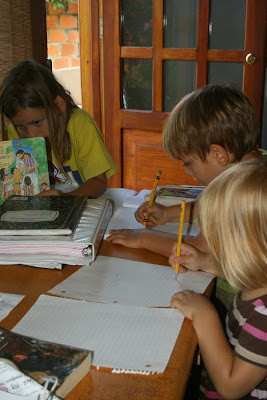
In the picture above, the boys are copying from an electronic version of Spelling Wisdom Book 3, and here Bria's using Book 1. Her attention has improved significantly over the last 2 weeks of school! 
I'm so proud of her! ;)


Tricia Hodges presents Tree Reflection: A Pastels Tutorial.

Cindy West presents The Study of a Twig.

Andrea @ Mosaic Ideas presents Mosaic Ideas for All Ages.

Kelly @ The Homeschool Co-op presents What Really Makes Our Kids Happy?.


The next CMBCarnival will be:
Religious Studies - 11/8
Suggested Reading:
CM vol.3 p137ff & vol.6 p.159-169
Parent's Review article: A Boy's Religion & The Development of the Religious Instinct in the Child

Submit your posts here!

Would you like to submit related photos or art to the upcoming carnival?  In keeping with the theme, I'd love to use other CMer's things, if your items are chosen, full credit will be given.  If you are interested, please send an e-mail to: charlottemasonblogs (at) gmail (dot) com.

Narration, just one part of the whole.

Can I just say that I didn't really believe that narrating, dictation and copywork were enough to teach my kids how to write? Well, it's true. I had my serious doubts in the beginning.  I admit it...  until somewhat recently, I always supplemented.

Don't get me wrong, we have always narrated. We started copywork and studied dictation at the corresponding appropriate ages. But I didn't believe. I didn't really think that could possibly be all.

Well, somewhere along the road, I became a believer. Some of us must see to believe :) My boys are finally old enough, or is it that I've finally been on this living education road long enough to trust that Charlotte Mason knew what she was talking about? Whatever it is, I love her. Our home and school are SO much more enjoyable because of the influence of her thoughts and experience.


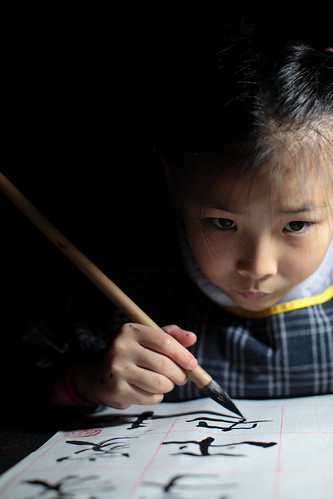
2011年春聯習作 II
image courtesy of uffizi_c


I could say more, but time would fail me... so I'll just link to some highlights!

A quote from Elsie Kitching clearing up some misunderstandings of CM's use of Language Arts, applies in our day as well:
'I had a letter from the Headmistress of a large Secondary School the other day, in which she said, "I do not think there is any difference between our use of narration and yours, except that we have it by way of composition the next day, and you have it immediately." I could only answer that there was a very great deal of difference. Compositions may always be set on subjects, taken from the work, which have been narrated. This is not the repetition of the child's first effort of attention, but a fresh effort to use his mind in another way. The composition probably calls for a summary, or a portion of what the child has read, in depicting a character or in discussing the pros and cons of any point, with illustrations from the general reading of the week.

May I say that Miss Mason's Method is at present suffering from the prevalent idea that her Method is narration, and chiefly the narration of English. Her Method covers the whole of a child's school life, in fact the whole of his life; the habit of narration is the means by which we all make anything our own to which we give full attention.

It has been said, on the other hand, that the one effort of attention and the one narration implies that the child must never do anything a second time, which is again a very much mistaken interpretation of Miss Mason's teaching. The second time may, as I have said, come in the way of composition later on; it probably comes again in the end of term examination, and certainly, if the child is interested, frequently in after life. There are also in the upper Forms the interesting sidelights which one book or subject throws upon another, sometimes covering the same ground from another point of view.'


Helpful links:
AmblesideOnline's Language Arts Scope and Sequence
AO notes on Language Arts
We Narrate and then We Know
AO narration page
An Advisory member's narration journey.
Some helpful answers to common questions on narration.
Some Notes on Narration - a Parent's Review article
AO copywork page

One of our own copywork lessons at Fisher Academy
A dictation lesson from the Parent's Review

Saturday, August 28, 2010

What does SWR stand for?

Spell to Write and Read.
Where does one begin when trying to describe such a comprehensive language program?!  If you are looking for Spelling/Grammar/Writing/etc program to meet ALL your needs... check it out!  seriously.
I guess the name sums up the theory and very succinctly, the practice too:

Spell (using the 70 basic phonograms + spelling rules)
       to Write (using as many senses as possible, including but not limited to writing)
                and Read (the goal is to have EXCELLENT, well-rounded readers!).

So how does it work?
A child masters the single letter phonograms before beginning the program.
The parent dictates a list of 20 words a week (for the youngest children) or 2 lists/wk with a grand total of 40 words for the older kids.
Dictation includes distinguishing syllables, think-to-spell pronunciation, finger spelling, writing from memory (visualization), seeing it written, analyzing spelling rules and making appropriate markings to illustrate. 
*(Even though you can use the material itself for copywork, I like to use the SWR word lists to select assignments from Spelling Wisdom!)


Ahem.... Here I'm doing finger spelling.
I know, you thought I was a rapper and showing my special sign, right? 
Also, please take notice of my special hair thing...


Which words does it teach?
The lists are arranged from a study of the most commonly used words in the English language.
Each word is accompanied by a sentence from classic literature, the Bible or from famous quotes, in order for the student to learn it in a context.

Parent Support:
There is an e-mail support group, there are workshops for the parent to learn how to better use the program (which I HIGHLY recommend attending) in many different States all year round.

Is it CM friendly?
Hmmm.  If you can assure me that the CM and/or AO police are not reading this blog, then I can say... yes and no.  It doesn't follow her language lessons exactly, but it can be very adaptable.  It would take a whole post to prove that!  :)   If she were alive today, I honestly think she would be impressed with the curriculum!  ;)

Here are several reviews:
Cathy Duffy top 100 picks
Britta McColl - SWR trainer, and my self-proclaimed mentor :)
(Britta also has a blog that has SUPER helpful posts!)


Don't worry... this was their own idea.
They were having some difficulty keeping quiet though ;)

Cost:
The program is intended for use from K-12, so for less than $100 you get the kit that will set you up for life!  The books are available separately, but honestly, you need the whole kit... and it's WORTH it!

Check prices and purchase:

Buy from amazon.com
& I get a commission!
Buy from Morning Star Learning
and receive support from Britta!
Check out the publisher's
website for a list of
all SWR materials available!


I posted a LONG time ago about SWR after having attended a Basic Training course in Minnesota with Britta McColl... have a peek of that here.

And just for fun, I took a video when one day when I was teaching my littlest littles how to write their basic phonograms in cursive (yes we use Cursive First as well).  We're doing full body writing of the letters... works REALLY well with wiggly kiddos!  (don't make fun of me!! ;)

Tuesday, March 2, 2010

Copywork: an assignment

Copywork

{an assignment}


Pippa's Song by Robert Browning

We actually pulled this exercise from Spelling Wisdom to coincide with our spelling list from Spell to Write and Read.  I love that Javen adds his personal touch to all his work.  This time drawing in the illuminated first letter.  He's very clever.

My rule for copywork is that it has to be a perfect copy the first time.  This includes spelling, punctuation and handwriting.  So, obviously I am careful in which passages I choose for them.  Normally they would have the selection right in front of them printed off the computer using a cursive font.  Today, since most of the words are words they have either had on their spelling lists or words that I thought they should have no problem with, we decided to do straight dictation.  I read the passage phrase by phrase (giving prompts where necessary).  They in turn wrote the passage down.  We are just beginning to do this and haven't done very much so I'm very proud of them!  This is not Javen's best work as far as neatness, but I was rather excited about his illumination!  :)  We got a double whammy with this selection as we were then able to discuss the poetry in a casual way, rhyme, repetition, etc.
"No work should be given to a child that he cannot execute perfectly, and then perfection should be required of him as a matter of course.  For instance, he is set to do a copy of strokes, and is allowed to show a slateful of all sorts of slopes and all sorts of intervals; his moral sense is vitiated, his eye is injured. Set him six strokes to copy; let him, not bring a slateful, but six perfect strokes, at regular distances and at regular slopes. If he produces a faulty pair, get him to point out the fault, and persevere until he has produced his task; if he does not do it to-day, let him go on tomorrow and the next day, and when the six perfect strokes appear, let it be an occasion of triumph. So with the little tasks of of painting , drawing, or construction he sets himself- let everything he does be well done. An unsteady house of cards is a thing to be ashamed of. Closely connected with this habit of 'perfect work' is that of finishing whatever is taken in hand. The child should rarely be allowed to set his hand to a new undertaking until the last is finished."
Charlotte Mason's Original Homeschooling Series - Vol. 1, pg. 160
We started with easy copywork from pretty young age.  In those earlier days my husband felt a lot more pressure to keep our kids on the level.  Anyone else have experience with this?  A husband who doesn't really get the whole more Charlotte Mason realm?  Well, he has loosened up somewhat as he sees the benefit of the 'education is an atmosphere, a discipline, a life.'  Bria (recently 7yo) in AOY1 has started copywork, but it isn't forced at all.  She does a lot of copywork apart from school entirely of her own initiative (writing letters, making play money and receipts, etc.).  I have not officially taught her handwriting yet.  Though over the last several months she has started to write on her own, having taken the last year to really master all the letters (we learn them in the form of the 70 basic phonograms a la SWR).  She is definitely learning by a more relaxed route.  We are still very much in the stage of fostering her love for learning.


How do you do copywork and dictation?  What age do you start?
Related Posts with Thumbnails

Blog Archive